By The UNJ Research Team: Hafid Abbas, Adi Irvansyah, Retno Dwi Lestari and Sri Kuswantono
In Southeast Asia, peace is usually discussed through treaties, diplomacy and conflict prevention. Yet peace is also produced in ordinary places where young people learn, work and live together across differences. Universities and the cities surrounding them may therefore constitute an overlooked infrastructure of peace.
This proposition underlies the Peaceful Student City Ranking 2026, which integrates contemporary student-city indicators associated with QS with President Soekarno’s vision of the “Student City” articulated in the 1950s. Rather than measuring a city simply by the number or prestige of its universities, the framework considers whether academic quality, safety, affordability, employment opportunities, cultural diversity and international engagement form a mutually reinforcing ecosystem.
The comparison between Indonesia and the Philippines offers an instructive starting point. Yogyakarta and Malang share the highest position on Indonesia’s dedicated peacefulness indicators, while Quezon City leads the Philippine comparison. More importantly, these findings suggest that cities should not merely host universities: they can become urban laboratories for peace.
First, peace should be understood as an urban ecosystem, not merely the absence of violence.
A peaceful student city requires conditions that enable young people to learn, interact and participate in society with confidence. Safety is essential, but it is only one component. Affordable living, accessible public transportation, employment prospects, cultural openness and opportunities for international interaction also influence whether students can experience difference constructively.
This broader conception is consistent with Soekarno’s early vision of the student city as an intellectual and social ecosystem. His 1953 conception emphasized intellectual vitality, cooperation among campuses, cultural harmony and the circulation of knowledge and people. Contemporary indicators add dimensions that can be empirically assessed, including university quality, safety, affordability, employability and internationalization.
Peace, therefore, should be understood positively: not simply as the absence of conflict, but as the presence of social conditions that enable people to develop relationships of trust and cooperation.
Second, Yogyakarta demonstrates how education, culture and opportunity can reinforce urban peace.
Indonesia’s enormous higher-education landscape makes meaningful city-level comparison difficult. Among the principal cities examined are Jakarta, Bandung, Yogyakarta, Semarang, Surabaya, Malang, Makassar and Padang. On the dedicated peacefulness indicators, however, Yogyakarta and Malang share first place, each scoring 10.
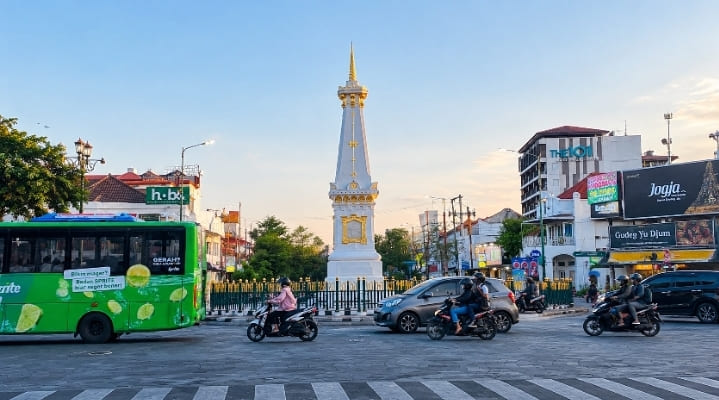
Yogyakarta has a particularly compelling claim as Indonesia’s emblematic peaceful student city because several advantages converge there. It is one of the country’s longest- established educational centers and home to Gadjah Mada University, while its cultural traditions and comparatively affordable student environment attract young people from across Indonesia.
The city’s labor-market performance strengthens this ecosystem. The research records Yogyakarta’s unemployment rate at 3.48 percent in 2024, the lowest among the Indonesian cities examined, compared with 4.91 percent in Surabaya. Employment matters because a genuinely peaceful city should not merely protect students from insecurity; it should also provide pathways from education toward meaningful economic and social participation.
Yogyakarta thus illustrates how cultural diversity, educational concentration, mobility and opportunity can transform a university town into an urban learning community.
Third, Quezon City shows how academic density and internationalization can strengthen the same peace ecosystem.
The Philippine comparison examines Quezon City, Manila and Cebu, with Quezon City emerging first. The integrated assessment records 19 reputable universities and a total score of 44, ahead of Manila at 34 and Cebu at 24. Its advantages include strong performance on peacefulness, international-student presence and relatively favorable living costs.
Internationalization is particularly significant. At the University of the Philippines and Ateneo de Manila University, international students account for approximately 1.81 percent and 2.44 percent of total student populations respectively. Such diversity creates opportunities for students to encounter different cultures and perspectives not through textbooks, but through everyday interaction.
Quezon City’s employment environment also contributes to its attractiveness, with unemployment reported at approximately 3.8 percent, second among the three Philippine cities after Cebu.
The important point is not that Quezon City is peaceful because of any single indicator. Rather, its experience suggests that academic concentration, international engagement, affordability, employment and urban security can reinforce one another. In this sense, the city operates as an educational ecosystem in which peace becomes part of the learning experience.
Fourth, ASEAN should treat peaceful student cities as regional infrastructure for cooperation.
Yogyakarta and Quezon City are very different. Yogyakarta is shaped by Javanese cultural traditions and a distinctive educational atmosphere; Quezon City is a large metropolitan academic center with extensive social and international diversity. Yet their experiences reveal a common ASEAN lesson: peace can become an educational asset.
The five dimensions underlying the comparative framework—reputable universities, peacefulness, living costs, employment opportunities and international students—can be viewed as components of a broader regional peace architecture. Universities generate intellectual capital; safe cities create confidence; affordability expands access; employment promotes economic security; and international students create everyday opportunities for intercultural understanding.
ASEAN could build on this potential by developing a network of peaceful student cities linking Yogyakarta and Quezon City with other university centers across Southeast Asia. Such a network could promote student and faculty mobility, joint degrees, peace and conflict-resolution programs, collaborative research and community-based intercultural dialogue.
The value of a ranking, therefore, should not be limited to identifying which city comes first. Its greater purpose should be to encourage cities to improve the conditions that allow young people to live and learn peacefully.
The ultimate test is straightforward: can a city enable young people to learn without fear, live with dignity, encounter difference with curiosity and develop the capacity to resolve disagreements constructively?
If so, the city is doing more than producing graduates. It is producing citizens of peace.
For ASEAN, where social tensions, inequality, identity differences and unresolved disputes continue to challenge regional cohesion, investing in such urban laboratories may prove to be one of the most practical forms of peacebuilding available.
The deeper significance of Yogyakarta and Quezon City is therefore not where they rank today, but what they can become tomorrow. If ASEAN is serious about building a peaceful and people-centred Community by 2035, its cities and universities must become active partners in that endeavour—places where young people from different nations learn not only with one another, but from one another. A regional network of peaceful student cities could turn everyday mobility, education and cultural encounter into a living architecture of trust across borders. The ASEAN Community of 2035 should not be defined only by the absence of war, but by the presence of generations who have learned to understand differences, resolve disagreements and cooperate across them. In that sense, every peaceful student city can become a small laboratory for the larger ASEAN dream: one region, many cultures, but a shared commitment to live together in peace.




![Spanduk raksasa yang dipasang aktivis Greenpeace Indonesia di atas Patung Selamat Datang Bundaran HI, Jakarta Pusat. [Foto: Greenpeace Indonesia]](https://rilpolitik.com/wp-content/uploads/2026/10/1000076504-350x220.jpg)