By Hafid Abbas
Promotor of Honorary Doctorates for President Nelson Mandela (2005) and Prime Minister Xanana Gusmão (2026), both conferred by Hasanuddin University (UNHAS)
After visiting and studying the Martin Luther King Jr. National Historical Park in Atlanta in April 2004, the Mark Twain House & Museum in Hartford in October 2006, and, most recently, the Rahmat International Wildlife Museum & Gallery in Medan in September 2026, I found myself reflecting on an unexpected connection among these three places, separated by thousands of kilometers and representing very different worlds. Yet each has transformed a person’s life, passion and legacy into a public space of learning—inviting us to remember, to reflect and, ultimately, to take greater responsibility for the future.
At first glance, Mark Twain, Martin Luther King Jr. and Rahmat Shah appear to have little in common. Twain was a writer; King was a civil-rights leader; Rahmat Shah is an Indonesian conservationist and museum founder. Yet each left behind something larger than a personal biography: a place where future generations can learn from a life devoted to something beyond oneself.
Three lives, three classrooms
The Mark Twain House & Museum in Hartford preserves the home where Samuel Langhorne Clemens—Mark Twain—lived from 1874 to 1891 and wrote some of his most influential works, including The Adventures of Tom Sawyer and Adventures of Huckleberry Finn. The house has become more than an historic building. It is a classroom of literature, imagination and American social history.
Atlanta offers another kind of classroom.
The Martin Luther King Jr. National Historical Park preserves King’s birthplace, childhood home, Historic Ebenezer Baptist Church and other sites associated with his life and legacy. Together, these places allow visitors to encounter the physical setting from which a movement for civil rights and nonviolent social change emerged.
If Hartford preserves the memory of ideas expressed through literature, and Atlanta preserves the memory of a struggle for human dignity, Medan offers something different but equally important: the memory of nature itself.
From Medan to the world
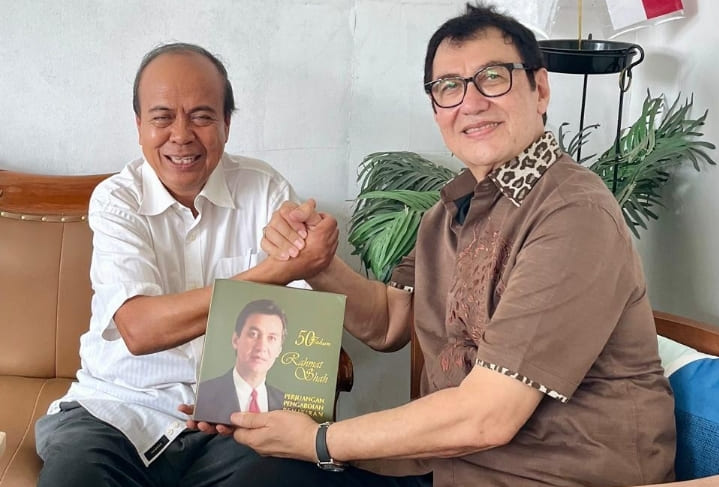
This brings us to Medan and Dr. H. Rahmat Shah. The Rahmat International Wildlife Museum & Gallery represents a different kind of educational memory: the memory of the natural world.
According to Indonesia’s Ministry of Culture, the museum was inaugurated in 1999 and expanded into a facility of approximately 3,000 square meters, with around 2,500 species, before its expanded building was inaugurated by President Susilo Bambang Yudhoyono in 2007. Other museum-related sources cite approximately 2,600 species and about 5,000–5,500 specimens from around the world.
Its founder, Dr. Rahmat Shah, built the institution out of a lifelong passion for wildlife and a stated commitment to preventing the extinction of forests and endangered animals. Indonesia’s Ministry of Culture describes the museum’s purpose as introducing the diversity of wildlife around the world and encouraging society to care for wildlife and the environment.
This is what makes Rahmat Gallery extraordinary.
A child in Medan does not need to travel to Africa to encounter the diversity of its wildlife. Nor does a student need to travel across several continents to begin understanding the extraordinary variety of species inhabiting our planet.
In one institution, visitors can encounter thousands of specimens representing wildlife from different parts of the world.
It is, in that sense, a global wildlife classroom in Indonesia.
Three forms of heritage
The deeper connection among Hartford, Atlanta and Medan lies in three forms of memory. Mark Twain represents intellectual and literary heritage. Martin Luther King Jr. represents human-rights and nonviolence heritage. Rahmat Shah represents a growing heritage of humanity’s relationship with nature.
One teaches through words. One teaches through social struggle. One teaches through the natural world.
Together, they suggest that the museum of the future should not simply preserve objects. It should create encounters that educate conscience.
This is particularly urgent today. The world is confronting biodiversity loss, habitat destruction and the growing distance between younger generations and nature. Preserving wildlife knowledge is therefore not merely about remembering what existed. It is about strengthening our determination to protect what remains.
From Medan toward UNESCO
Could Rahmat Gallery eventually contribute to UNESCO’s global heritage conversation?
The idea deserves serious exploration, but with an important distinction. UNESCO’s Memory of the World Programme concerns documentary heritage—archives, manuscripts, photographs, audiovisual materials and other records that preserve humanity’s collective memory.
Therefore, the strongest proposition would not simply seek UNESCO recognition of the museum’s physical specimens. Indonesia could instead explore the creation of a Rahmat Wildlife Documentary Heritage Collection comprising its historical catalogues, photographs, scientific and conservation records, field documentation, acquisition records, audiovisual materials and educational archives.
If properly preserved, digitized, documented and demonstrated to have the required global significance, such a documentary collection could provide a meaningful basis for exploring a future Memory of the World nomination.
This would give the initiative a larger philosophical meaning: Indonesia would not merely preserve a collection of wildlife; it would preserve humanity’s recorded memory of the natural world.
A heritage for the future
The ambition should now be to connect Rahmat Gallery with universities, museums, conservation organizations and schools internationally. Every specimen should ideally have a comprehensive digital record. Educational programs could bring biodiversity into classrooms, while researchers could use the collection as a platform for comparative learning and public conservation education.
This is how a museum becomes more than a destination. It becomes a living classroom.
Hartford shows how a house can preserve the imagination of a writer. Atlanta shows how a neighborhood can preserve the memory of a movement for human dignity. Medan has the opportunity to show how a museum can preserve humanity’s encounter with the living world.
There is also a deeper human quality connecting these legacies. Rahmat Shah’s compassion and dedication to humanity and nature recall, in different ways, the spirit of Mahatma Gandhi, Martin Luther King Jr., Mother Teresa and Mark Twain—figures who transformed their convictions, talents and personal journeys into legacies that continue to educate and inspire. Rahmat’s distinctive contribution is to extend that spirit of responsibility to the natural world, reminding us that compassion must embrace not only humanity, but also the wildlife and environment upon which our common future depends.
Perhaps that is the future of heritage: not only preserving what humanity has created, but also preserving what humanity has inherited—and teaching future generations to protect it.