By: Hafid Abbas
International Consultant at SEAMEO RETRAC, Ho Chi Minh, 2014
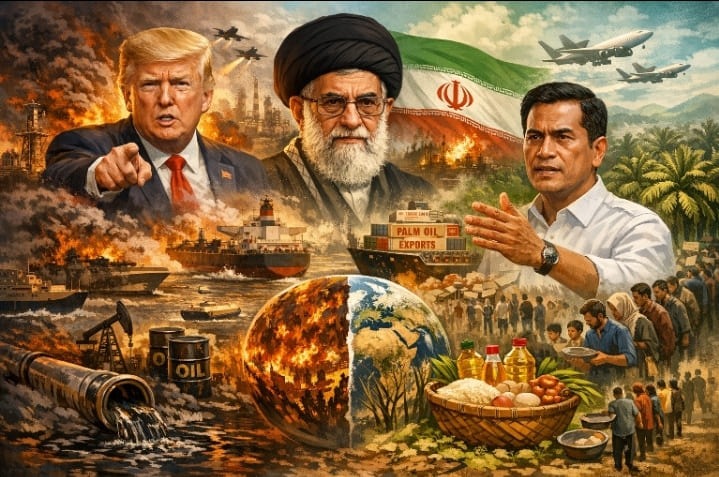
In the rapidly changing geopolitical landscape, the current conflict between the United States and Iran has sent shockwaves across the world. As President Donald Trump’s threats to “destroy” Iran’s infrastructure grow more imminent, Iranian Supreme Leader Ayatollah Ali Khamenei’s unwavering stance against the U.S. and Israel fuels fears of an all-out war. But within this tense standoff, an unexpected player is making bold moves that could shake the global order — Indonesia. Minister of Agriculture, Andi Amran Sulaiman, has warned the world that while Iran may control a significant portion of global energy via the Strait of Hormuz, Indonesia holds an even more critical leverage: the power to disrupt the world’s food supply by halting its palm oil exports. This statement presents a pressing dilemma: Could Indonesia, as a leading supplier of palm oil, use its geoeconomic power to hold the world hostage in the event of further escalation?
Trump’s Stark Warning to Iran: A Military Showdown
In recent comments, former U.S. President Donald Trump has amplified tensions by declaring that the U.S. military has the capability to “cripple” Iran in a single night. His words are not just a reflection of the growing hostility between the two nations but a direct threat that Iran could face severe consequences if it does not comply with U.S. demands. Trump’s rhetoric, coupled with military deployments and aggressive maneuvers, is creating a precarious situation, where the entire Middle East could be thrust into chaos.
Trump’s latest remarks underscore the danger at hand: “Iran faces a deadline, and if they do not comply, we will dismantle their infrastructure in one night.” This threat follows the U.S.’s continued military operations, including more than 10,000 combat flights and the targeting of over 13,000 military assets in Iran, sending a clear signal of American resolve. As tensions rise, the fate of Iran, its allies, and its global partners hangs in the balance.
Iran’s Strategic Importance: The Strait of Hormuz and Energy
While Trump focuses on military strikes, Iran’s strategic control over the Strait of Hormuz remains central to the crisis. This narrow waterway handles roughly 20% of the world’s oil supply, making it a crucial chokepoint for global energy markets. In this high-stakes environment, Iran has repeatedly threatened to block this vital route, sending shockwaves through oil prices and global energy security. This threat is not empty — a blockage could disrupt oil shipments to some of the world’s largest economies and potentially send energy prices skyrocketing.
However, while the global community focuses on Iran’s power over energy, Indonesia, as a powerhouse of agricultural exports, holds a different form of leverage: the palm oil supply chain.
Indonesia’s Palm Oil Power: Amran’s Geoeconomic Threat
Indonesia’s position in the global palm oil market is nothing short of pivotal. As the world’s largest exporter of crude palm oil (CPO), Indonesia accounts for around 32 million tons of CPO exports annually — a vital ingredient found in countless consumer products, from food and cosmetics to pharmaceuticals. Andi Amran Sulaiman, Indonesia’s Minister of Agriculture, made a bold declaration: if Indonesia were to halt its palm oil exports, the global food system would face a catastrophic crisis.
Amran’s warning was stark: “If we stop exporting CPO, the world will face a catastrophe.” Unlike oil, which can be substituted with other energy sources, palm oil is embedded in so many industries that no easy replacements exist. From cooking oil to personal care products, Indonesia’s palm oil is integral to the global economy. A sudden halt in exports could lead to a chain reaction of shortages, skyrocketing prices, and widespread food insecurity.
Amran’s statement was not just hyperbole; it was a calculated reminder of Indonesia’s significant role in the global supply chain. In the event of an escalation in global tensions, especially in the Middle East, Indonesia could leverage its palm oil exports as a form of economic warfare — a stark reminder that food security can be just as decisive as energy security.
Geoeconomic Warfare: A New Dimension of Conflict
As the U.S. and Iran engage in a dangerous game of military and diplomatic escalation, Indonesia’s ability to control the global food supply introduces a new form of warfare: geoeconomics. While energy security remains a top priority in international relations, Indonesia’s agricultural dominance highlights the fragility of the global food system. Amran’s words reflect a critical truth — “Iran can darken the world with oil, but we can make the world go hungry.” The global supply chain is a delicate web, and in times of geopolitical instability, any disruption in food production or trade could have severe, cascading effects on nations far beyond Indonesia’s shores.
In this new era of geoeconomic confrontation, both energy and food are being weaponized. While the U.S. and Iran may be locked in a battle for control over oil and energy resources, Indonesia’s strategic control over palm oil presents an equally potent threat to global stability. The intersection of these two critical resources — energy and food — forms a volatile mix that could lead to unprecedented global turmoil.
The Global Impact: From Energy Crises to Food Shortages
The current conflict between the U.S. and Iran, combined with the looming potential for food shortages due to Indonesia’s agricultural power, illustrates the complex interdependence of global markets. While the world may eventually adapt to energy disruptions caused by Iran, it may not survive a widespread food crisis. Rising food prices, exacerbated by a disruption in palm oil exports, could spark food riots, economic collapse, and political instability in countries around the world.
The global food system is built on fragile networks of trade and supply, and any break in this chain can have devastating consequences. In a world where oil and food are both under threat, nations will find themselves caught in a struggle for survival. With geopolitical forces pushing these critical resources to the brink, the international community faces a dire need for collaboration and conflict resolution.
Conclusion: A Dangerous Crossroad for Global Security
As tensions rise between the U.S. and Iran, and Indonesia stands poised to exercise its control over the global food supply, the world finds itself at a dangerous crossroads. While military conflict over oil and energy remains the central focus of the U.S.-Iran standoff, the specter of global food insecurity adds another layer of complexity to the crisis. Indonesia’s palm oil dominance could serve as an unexpected counterpoint to military might, making it clear that geoeconomics, in addition to traditional military strategies, is becoming a critical tool in the modern global order.
The question remains: How will nations navigate this dangerous new landscape? With the stakes higher than ever, it is essential for world leaders to prioritize cooperation and dialogue before further escalation leads to catastrophic consequences for both energy and food security. As Trump, Khamenei, and Amran hold the keys to global power in their respective domains, the world watches closely, hoping for a resolution that avoids both war and hunger.
In the end, the world cannot afford to let power over energy and food become instruments of destruction rather than foundations for shared survival. The escalating tensions among leaders such as Donald Trump, Ali Khamenei, and Andi Amran Sulaiman reveal not only the fragility of global systems but also the urgent necessity of restraint, empathy, and dialogue. As Mahatma Gandhi wisely reminded humanity, “An eye for an eye only ends up making the whole world blind.” In a time when both war and economic coercion threaten to deepen human suffering, this enduring truth calls on nations to choose cooperation over confrontation, and compassion over coercion—recognizing that true security lies not in domination, but in our collective commitment to peace, dignity, and the preservation of life.”



![Gedung KPK, Jakarta Selatan. [Foto: Ah/rilpolitikcom]](https://rilpolitik.com/wp-content/uploads/2025/02/IMG-20250222-WA0001-350x220.jpg)