By: Hafid Abbas
Director, Center for Global Peace and Conflict Resolution at Hasanuddin University
When considering whether Indonesia might put forward Prof. Dr. Yusril Ihza Mahendra as a candidate for United Nations secretary-general, it is useful to look beyond Indonesia and revisit a historical precedent: Boutros Boutros-Ghali of Egypt, the sixth UN secretary- general, who served from 1992 to 1996.
The comparison does not suggest that the two men have identical careers or political traditions. They plainly do not. Rather, it raises a broader question: what kind of national experience can prepare a person for international leadership?
Boutros-Ghali offers one answer. He was not a career UN official when he reached the UN’s highest office. He arrived there after decades as a scholar of international law, university professor, parliamentarian, political figure, foreign minister and deputy prime minister. The UN describes him as a diplomat, jurist, scholar and author who spent more than four decades engaged with international law, human rights, development, decolonization, humanitarian law, non-alignment and Afro-Arab cooperation.
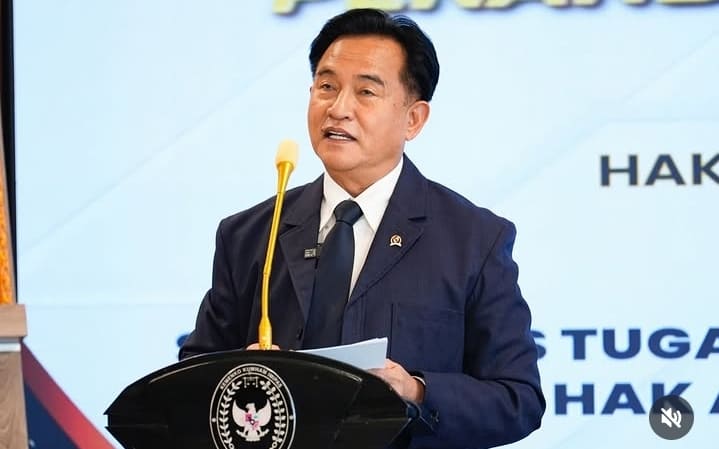
There is an intriguing parallel with Yusril. A constitutional-law scholar and lawyer, Yusril has moved between academia, politics and government. Since October 2024, he has served as Indonesia’s Coordinating Minister for Law, Human Rights, Immigration and Corrections.
The significance of the comparison lies not in identical résumés, but in the intersection of law, scholarship, politics and executive government.
From scholarship to statecraft
Boutros-Ghali spent nearly three decades as Professor of International Law and International Relations at Cairo University after earning his doctorate in international law from Paris University in 1949. He later joined the International Law Commission and became involved in international legal and academic institutions.
But he did not remain an academic observer. He entered political life, became a member of the Egyptian Parliament, served as Minister of State for Foreign Affairs from 1977 to 1991 and became Deputy Prime Minister for Foreign Affairs in 1991. He also led Egyptian delegations to the Organization of African Unity, the Non-Aligned Movement and UN General Assembly sessions.
That combination mattered.
International organizations need diplomats who understand negotiation, but also leaders who understand how governments make decisions. They need lawyers familiar with international obligations, but also political actors who understand the domestic pressures behind those obligations.
Boutros-Ghali stood at that intersection.
Yusril’s career represents a different national experience, yet it similarly crosses legal scholarship, political institutions and executive government. His constitutional-law background is particularly relevant to questions increasingly confronting the international system: the relationship between sovereignty and law, state authority and individual rights, and domestic constitutional arrangements and international commitments.
This does not automatically qualify anyone for international diplomacy. But it can provide an intellectual foundation for engaging with some of the central dilemmas facing the UN.
The Global South perspective
A second point of comparison concerns national experience. Boutros-Ghali came from Egypt, situated at the intersection of Africa, the Arab world, the Mediterranean and the Non-Aligned Movement. His career exposed him to several political and regional constituencies.
Indonesia occupies a different but equally distinctive position. It is a large Southeast Asian democracy with a long tradition of engagement in ASEAN, the Non-Aligned Movement and the developing world.
National experience does not mean that a secretary-general represents a particular religion, region or political bloc. The secretary-general is an international civil servant expected to serve the entire UN membership.
Yet national experience can shape the questions a leader brings to the international table.
Indonesia’s history of managing extraordinary diversity while developing a constitutional democracy offers one perspective on the relationship between sovereignty, pluralism, development and international cooperation. Its long-standing foreign-policy tradition of strategic autonomy also provides experience in navigating relations among competing major powers.
These experiences could contribute to a wider conversation about how multilateralism can remain relevant in an increasingly fragmented world.
From Cairo to New York
The most important lesson from Boutros-Ghali may be that his path to the UN was cumulative. His legal education gave him an understanding of international law. His academic career provided intellectual depth.
His political experience exposed him to domestic institutions. His ministerial career gave him executive experience. His diplomatic assignments connected these experiences to international negotiations.
By the time he arrived in New York, these strands had become one professional identity.
The same question can therefore be asked of Yusril: not whether he is another Boutros- Ghali, but whether his own experience across law, scholarship, politics and government could be considered relevant to a wider international role.
There is, however, an important caution. Boutros-Ghali’s appointment was not the automatic consequence of an impressive résumé. In 1991, Egypt’s candidate was considered alongside Bernard Chidzero of Zimbabwe and Olusegun Obasanjo of Nigeria. He was subsequently recommended by the Security Council and appointed by the General Assembly for a five-year term beginning Jan. 1, 1992.
The process illustrates the inherently intergovernmental character of the office. A national nomination is only the beginning. The secretary-general is recommended by the Security Council and appointed by the General Assembly, making the permanent members’ veto power a decisive part of the process.
A national candidacy and an international appointment are therefore two very different things.
What could Indonesia bring?
This is where the Boutros-Ghali precedent becomes most useful. If Indonesia were ever to consider Yusril as a candidate, the discussion should not rest principally on nationality or biography. It should address what an Indonesian candidate could contribute to the UN at a time when confidence in multilateral cooperation is being tested.
The questions are substantial: the credibility of international law; peaceful settlement of disputes; human rights; conflict prevention; institutional reform; and a stronger relationship between developed and developing countries.
Yusril’s constitutional-law background could offer one intellectual entry point into these questions. But the larger proposition would belong to Indonesia, not to one individual.
Indonesia’s contribution to the UN could draw upon its experience as a diverse democracy, an important country of the Global South and a longstanding participant in multilateral diplomacy.
That is why the Boutros-Ghali comparison is worth considering. It reminds us that international leadership does not necessarily begin inside an international bureaucracy. It can emerge from the intersection of law, scholarship, politics, government and diplomacy.
Boutros-Ghali travelled that road from Cairo to New York.
Whether Yusril’s career should be considered in a similar international context is ultimately a matter for Indonesia’s government, its diplomatic partners and UN member states.
The larger question, however, belongs to Indonesia itself: Can Indonesia translate its national experience into a meaningful contribution to the next chapter of multilateralism?
That question may be more important than any individual candidacy.
As Boutros-Ghali observed in 1992, democratizing international life requires the “fullest consultation, participation and engagement of all States, large and small.”
For Indonesia, that principle offers an enduring invitation: not merely to seek a place at the global table, but to bring ideas, experience and diplomatic imagination capable of strengthening the table itself.
With Yusril’s candidacy, Indonesia would also bring into the conversation a wider constituency that has long sought a stronger voice in the UN: ASEAN, the Organization of Islamic Cooperation (OIC), and the Non-Aligned Movement (NAM). Indonesia’s historic engagement with all three gives its candidacy a significance beyond one individual. It could be seen as an opportunity for these often under-represented perspectives of Southeast Asia, the Muslim world and the Global South to be heard more prominently in the search for the next chapter of multilateralism.